Commercial LED Downlight Buying Guide
Commercial buyers check every Commercial LED Downlight fixture using clear technical rules. Facility managers, architects, and professional builders focus on key performance measurements when planning ceiling projects. Aperture sizing directly controls how well the lights fit into the ceiling space. Lumen output sets the main brightness levels throughout business areas. CCT adaptability offers easy color temperature changes for different indoor settings. Driver reliability keeps heat moving away actively to ensure long-term system stability. Standard compliance ratings like fire, IP, and IC certifications ensure full safety code agreement. Guangdong Liyinled Lighting Co.,Ltd provides high-performance, factory-direct fixtures made to global standards. These well-designed lighting options smoothly balance attractive looks, safety compliance, and overall total cost of ownership.
Key Takeaways
Good business LED downlights give off strong light while reducing bright shine to keep workers comfortable.
Strong metal parts called die-cast aluminum heat sinks help lights last longer and protect inside electronics from getting too hot.
Fire-rated and IC-certified fixtures satisfy tough local safety rules and safeguard insulated building ceilings.
Built-in CCT switches let you easily change the light color on the job, which helps lower extra store costs.
Commercial LED Downlight Performance Metrics
Luminous Efficacy and Color Rendering
Optical performance evaluation requires a strict review of luminous efficacy and color rendering capabilities. Efficacy measures lighting efficiency in lumens per watt (lm/W). Standard commercial LED downlight fixtures target an output around 117 lm/W. High-quality fixtures reach various efficacy tiers depending on project goals:
Efficacy Tier | Luminous Efficacy Range (lm/W) |
|---|---|
Minimum | 90 |
Target | 100–120 |
Elite | 125–140 |
Operating temperature and color settings also alter energy output across installations:
2700K: −8% to −12% vs. 4000K baseline
3000K: −5% to −8% vs. 4000K baseline
3500K: −2% to −3% vs. 4000K baseline
4000K: baseline (e.g., 140 lm/W)
5000K: +3% to +5% vs. 4000K baseline
6500K: +5% to +8% vs. 4000K baseline
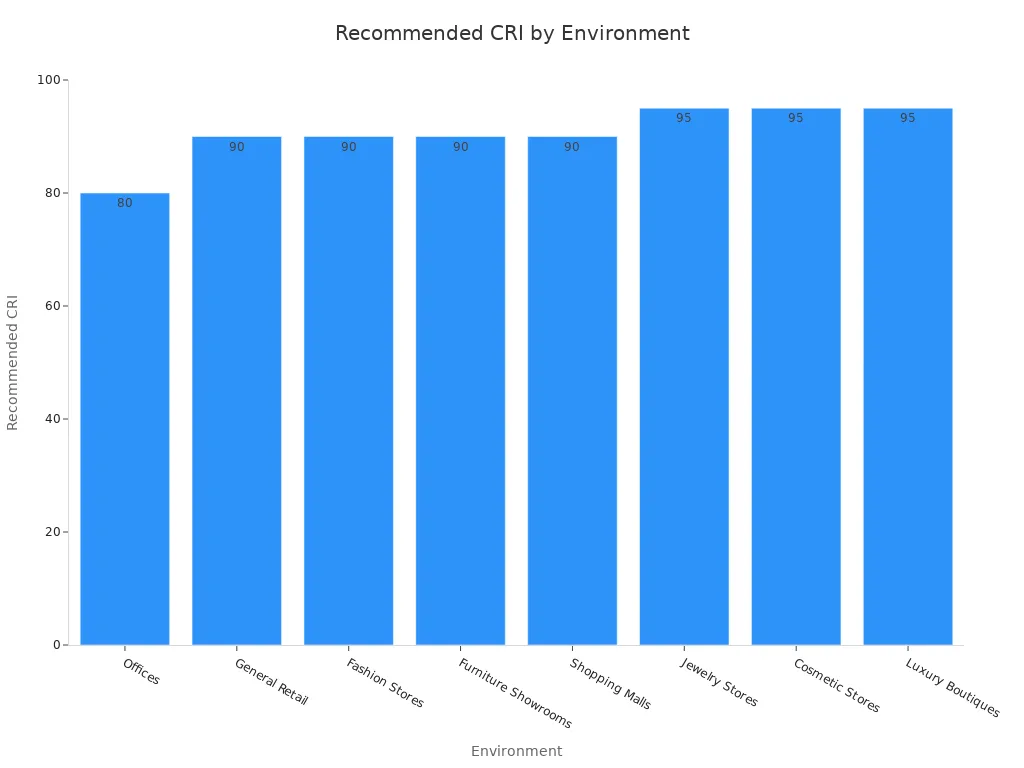
Color accuracy relies on the Color Rendering Index (CRI). Premium systems achieve up to 99 (Ra) for true color reflection. Specific commercial applications demand distinct CRI performance levels:
Environment | Recommended CRI |
|---|---|
Offices | CRI 80 |
General Retail | CRI 90 |
Fashion Stores | CRI 90+ |
Furniture Showrooms | CRI 90+ |
Jewelry Stores | CRI 95+ |
Cosmetic Stores | CRI 95+ |
Shopping Malls | CRI 90 |
Luxury Boutiques | CRI 95+ |
The governing photometric testing standard for measuring total luminous flux, efficacy, and CRI in commercial LED downlights is IES LM-79-19. Procurement teams should require an LM-79 report from an ISO 17025-accredited lab to verify performance claims.
Glare Control and Color Consistency
Visual comfort in office environments depends heavily on precise glare control. The Unified Glare Rating (UGR) system measures discomfort glare from indoor luminaires. The EN 12464-1:2021 standard mandates specific maximum visual glare thresholds for commercial interiors:
Space Type | Specific Area / Task | Recommended UGR Threshold | Governing Standard |
|---|---|---|---|
Office | Screen-based work (writing, typing, reading, VDT work) | ≤ 19 | EN 12464-1:2021 |
Office | Technical drawing and control rooms | ≤ 16 | EN 12464-1:2021 |
Educational | Classrooms | ≤ 19 | EN 12464-1:2021 |
Color consistency ensures uniform light appearance across multiple ceiling fixtures. Quality manufacturing maintains chromaticity tolerances lower than 3 SDCM (Standard Deviation of Color Matching). Low SDCM values prevent visible color variations between adjacent lights operating at identical color temperatures.
Selecting between Chip-on-Board (COB) and Surface-Mounted Device (SMD) light bases depends on spatial lighting requirements. Guangdong Liyinled Lighting Co.,Ltd supplies advanced COB and SMD architectures, including the premium APL-TD and APL-PB series downlights.
COB LEDs are characterized by: High light intensity, uniform illumination (eliminates spot patterns), and requirements for specific thermal management. They are commonly used in commercial and industrial general lighting (downlights, high-bay lights) and situations demanding intense, uniform light.
SMD LEDs are characterized: As a cost-effective, widely used technology. A key drawback for optical performance is the "dot effect" from separated diodes, which can require additional diffusers to achieve smooth lighting, making them less ideal for seamless accent lighting compared to COB.
COB models deliver focused, high-density beams ideal for architectural feature highlights. SMD models provide broader beam angles that distribute smooth light across wide office areas efficiently.
Commercial LED Downlight Optics and Design
Die-Cast Aluminum Thermal Management
Heat management directly influences operational life in high-output fixtures. Guangdong Liyinled Lighting Co.,Ltd builds fixtures using a die-casting aluminum radiator with exceptional heat dissipation efficiency. Premium die-cast aluminum housing rapidly draws thermal energy away from sensitive LED chips. This continuous thermal transfer protects optical components against heat damage.
Effective thermal control ensures stable long-term system performance. Efficient heat dissipation yields an L70 lifespan of 50,000 hours @L70/B50. The sturdy metal housing maintains structural strength inside ceiling cavities over years of continuous commercial use.
Trim Styles and Beam Angle Selection
Optical components control light direction and aperture appearance. Beam angle directly controls light distribution across a space. A wider beam angle expands light output across an interior without increasing total lumens, but reduces beam intensity measured in candelas. Precision optical lenses deliver uniform light with reduced glare, while aluminum reflectors enhance light output while maintaining visual comfort. Spot-type beams between 45 and 60 degrees create an intense hotspot to highlight architectural features. Flood-type beams provide wider, even coverage so contractors space fixtures further apart.
Specific business areas require targeted beam angle ranges. Retail feature products and mannequins require narrow beam angles between 15 and 24 degrees for high contrast. Retail wall displays use beam angles from 24 to 36 degrees for balanced coverage. General office lighting uses beam angles from 30 to 60 degrees to deliver uniform ambient light. Accent lighting on artwork uses tight angles from 10 to 24 degrees for spotlighting.
Trim Style | Key Physical Description | Primary Effect on Glare | Common Application Context |
|---|---|---|---|
Baffle | Trim with ridges inside aperture | Ridges trap stray light to reduce glare | General lighting prioritizing comfort |
Reflector | Trim with smooth interior | Produces direct, brighter light output | Spaces requiring maximum light output |
Gimbal | Lens tilts on an axis up to 35° | Controls glare by aiming light away | Accent lighting and sloped ceilings |
Commercial LED Downlight options adapt easily to complex project plans. Factory customization provides unique solutions for luxury installations.
Safety Standards and Code Compliance
Building codes strictly require safety compliance for commercial light setups. LED downlights must meet structural rules to safeguard people and property.
Fire-Rated and Environmental IP Ratings
Fire-rated lights protect the fire resistance of ceiling setups. Standard ceilings serve as barriers that stop fires from spreading fast. Cutting holes for recessed lights weakens these protective ceiling layers. Designers pick fire-rated lights to protect structural safety during emergencies. These special light frames contain materials that expand when exposed to heat. This swelling blocks air gaps completely during a structural fire. Safety inspectors check these ratings to ensure alignment with local laws.
Ingress Protection (IP) ratings show how well sealed light frames block dust and water. Designers match the IP rating directly to the room's conditions:
Environment / Location | Minimum IP Rating | Recommended IP Rating | Key Consideration |
|---|---|---|---|
Bathroom Zone 2 (near washbasins) | IP44 | IP44 | Minimum per electrical standards. |
Bathroom Shower Zones (Zone 1) | IP44 | IP65 | For direct water spray. |
Covered Outdoor (porch, canopy) | IP44 | IP65 | Upgrade for better protection. |
Exposed Outdoor (wall, facade) | IP65 | IP65 | Minimum B2B standard for outdoor. |
Wet Locations / Washdown Areas | IP66 | IP66 or IP67 | For powerful water jets or temporary immersion. |
Industrial Washdown | IP66 | IP69K | For high-pressure, high-temperature cleaning. |
Choosing the right IP rating keeps warranty coverage fully valid:
Warranty agreements directly list the certified IP rating of the fixture.
Brands accept claims only if lights sit in matching environmental conditions.
Damage from water leaks causes the most frequent warranty arguments.
Building managers demand official test papers to avoid warranty conflicts.
Guangdong Liyinled Lighting Co.,Ltd creates sealed light frames with tested IP ratings. Factory teams adjust housing seals to handle difficult wet area needs.
IC Ratings and Energy Certifications
Insulation Contact (IC) ratings show if lights work safely against building insulation. An IC rating means the fixture touches attic insulation safely without dangerous heat build-up.
Insulated ceilings: Only use housing with an IC rating or there is the potential for a fire hazard from heat build-up.
Installers must follow IC guidelines carefully when fitting new ceiling fixtures:
Insulated ceilings need an IC rating as a required feature for ceiling lights.
Non-IC frames placed inside insulated ceilings cause dangerous fire risks from high heat.
Non-IC frames require expensive fixes if installers place them into insulated areas incorrectly.
Smart installation crews check ceiling insulation types before placing recessed lights into business spaces. Checking these details early stops safety failures during final electrical reviews. Certified IC-rated downlights let heat escape safely using built-in metal cooling components. Premium lights from Guangdong Liyinled Lighting Co.,Ltd use sturdy die-cast aluminum heat sinks. These parts keep internal temperatures low even when covered by thick building insulation. Energy badges like ENERGY STAR prove light efficiency across large commercial jobs. Purchasing teams look at energy badges and IC ratings to meet local power laws. Custom factory options allow direct changes to light frames for unique ceiling plans. Guangdong Liyinled Lighting Co.,Ltd runs tough heat tests to earn official safety badges. Property managers feel confident when choosing fully tested fixtures for complex commercial ceilings. Following these combined safety rules guarantees quick building approvals while protecting real estate investments for years.
Installation Strategy and CCT Flexibility
Canless vs. Retrofit Commercial LED Downlight Options
Contractors pick direct-mount canless lights or traditional retrofit kits during building upgrades and new projects. Slim canless units drop bulky metal cans entirely. Workers easily insert these thin panels right into shallow ceiling gaps. Installing teams must keep clear spaces around light frames during retrofit jobs. Safe spacing stops heat build-up and protects ceiling insulation over long periods. Layout tests help workers check top ceiling space before cutting any holes.
Guangdong Liyinled Lighting Co.,Ltd makes flexible light frames and custom round downlights for hotels and offices. Factory engineers alter light bodies, heat seals, and spring clips for target ceiling depths. Past project records show clients successfully replaced thousands of old fixtures across corporate spaces without changing wiring. Custom factory choices allow fast changes to drivers, brightness levels, and trim colors for specific jobs.
3CCT Dip Switches and Layout Planning
Room design needs an even grid layout to spread light smoothly across big open spaces. Designers manage beam patterns and fixture gaps to build steady room light and lower eye strain. Picking lights with beam angles like 24°, 38°, or 60° limits glare. Low-glare Commercial LED Downlight units keep visual glare scores under UGR 19 in modern offices. High CRI options like Ra90 and Ra95 show true product colors on store floors.
Built-in 3CCT dip switches make stock tracking much easier for setup crews and supplier warehouses. Guangdong Liyinled Lighting Co.,Ltd offers three-color thin panels with adjustable power settings from 3W to 22W. Electricians flip physical switches right on the job site to set color tones before mounting. This quick field choice helps workers meet varied room needs with one product line while cutting storage costs.
Total Cost of Ownership and ROI
Operational Energy and Maintenance Savings
Upgrading your lighting to a modern Commercial LED Downlight lowers daily power bills quickly. Building managers gain great financial perks by replacing old, power-hungry ceiling bulbs. Energy savings can jump over ten times compared to old halogen or compact fluorescent lights. Managers figure out real savings by checking light wattage, yearly run times, local power rates, and replacement costs.
A complete cost plan tracks real maintenance work instead of just looking at the original price tag. Maintenance teams must account for worker pay, lift rentals, safety permits, and work delays alongside light prices. How often you swap equipment directly changes your multi-year operating budgets. Normal project payback times change depending on daily run hours and your current setup:
Retrofit Scenario | Payback Period |
|---|---|
24/7 warehouse application | 6 months |
Average commercial project | 14–18 months |
T8 troffer to 40W LED conversion | 18–24 months |
8-hour office space | 36 months |
Driver Reliability and Quality Assurance
LED drivers are the main point of failure in commercial ceiling light fixtures. High heat inside the ceiling puts delicate driver parts under heavy stress as time goes on. Dried-up capacitors break the driver long before the LED chip actually stops working. Top-grade commercial fixtures use internal electronic parts rated for 105°C or higher to ensure steady daily operation.
Guangdong Liyinled Lighting Co.,Ltd runs strict factory quality checks before sending fixtures to commercial jobs. Factory workers perform official IES LM80-08, IES TM-21-11, and IES LM-82-11 testing procedures. These standard tests verify total light output, beam strength, and color consistency across every single production batch.
Automated factory quality control includes fatigue tests that cycle fixtures on and off repeatedly to verify true product service life.
Guangdong Liyinled Lighting Co.,Ltd offers custom factory options for commercial clients around the world. Factory engineers adjust driver settings, frame depths, and mounting spring clips to fit unique ceiling update needs. Recent business project partnerships show these direct factory changes cut labor costs, prevent installation delays, and ensure long-lasting light performance.
Commercial buyers evaluate ceiling fixtures using strict technical standards. Facility managers analyze optical output, thermal construction, safety compliance, and color flexibility before finalizing project plans.
A comprehensive purchasing checklist contains critical evaluation steps:
Optical performance: Select high efficacy fixtures with UGR values under 19.
Thermal construction: Choose durable die-cast aluminum heat sinks for long operational life.
Code compliance: Verify official IC ratings and fire safety certifications.
Adaptive flexibility: Utilize field-selectable 3CCT dip switches to simplify site installation.
Partnering directly with Guangdong Liyinled Lighting Co.,Ltd secures certified quality and competitive factory pricing. Their engineering team delivers complete commercial LED downlight solutions with reliable long-term warranty support.
FAQ
What visual glare rating fits standard office spaces?
EN 12464-1:2021 rules say typical workspaces need a Unified Glare Rating (UGR) of 19 or less. Low UGR values protect computer workers from tired eyes and make long work shifts much easier on their vision.
How do field-selectable 3CCT dip switches help contractors?
With adjustable 3CCT dip switches, workers change color temperatures right at the job site. This smart feature means businesses keep fewer extra lights stored in warehouses. Electricians use one single light model to match different room needs fast.
What custom manufacturing and OEM capabilities does Guangdong Liyinled Lighting Co.,Ltd offer?
Guangdong Liyinled Lighting Co.,Ltd offers full OEM and ODM support for business building projects. The factory changes fixture wattages, CCT settings, beam angles, outer finishes, and driver specifications. They add private brand labels to match customer requests too.
Why do commercial ceilings require IC-rated LED downlights?
An Insulation Contact (IC) rating shows that ceiling lights safely touch attic insulation without starting fires. Built-in die-cast aluminum heat sinks push hot air away fast. This smart heat control keeps fragile electronics safe inside packed ceiling spaces.