100W vs 150W vs 200W LED High Bay Lights: How to Select the Right Power
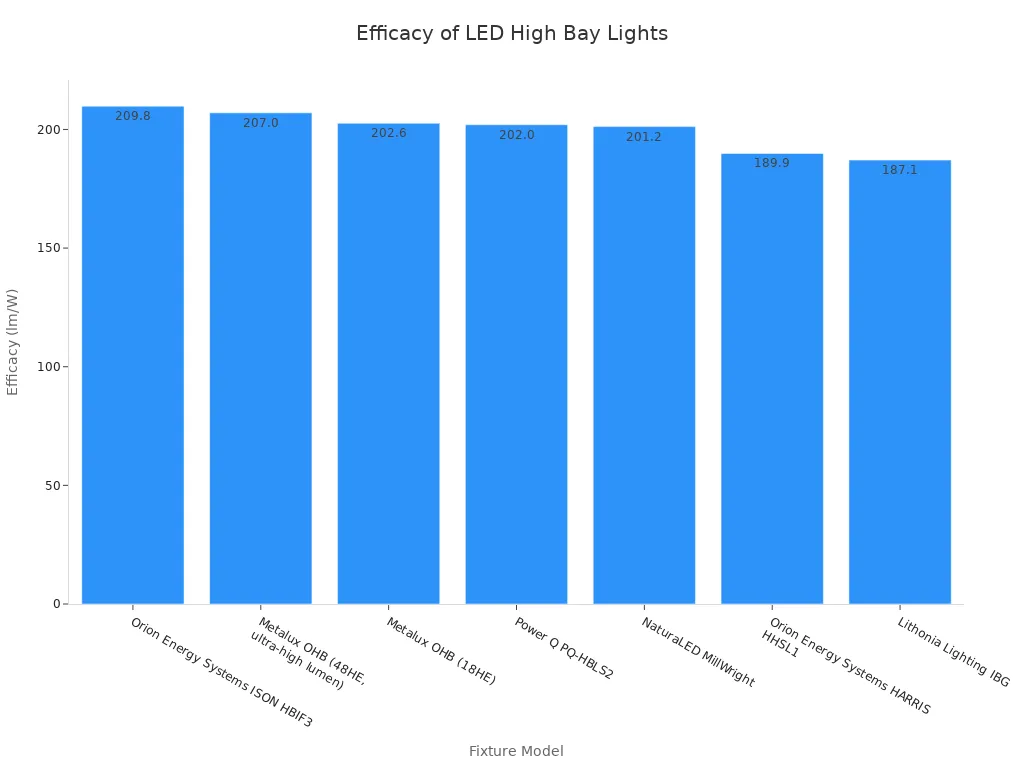
Picking the right wattage for LED High Bay Lights often confuses buyers. Lumens matter more than wattage. Modern fixtures give 187.1–209.8 lumens per watt. A 100W unit makes 13,000–14,000 lumens. A 150W unit can produce 15,000–22,000 lumens. Top performers do even better, as shown below.
Fixture | Efficacy (lm/W) |
|---|---|
Metalux OHB (18HE) | 202.6 |
Lithonia Lighting IBG | 187.1 |
Various LED high bay light models offer solid choices for different applications. Many manufacturers focus on energy-saving lighting. This guide gives a clear way to match power with ceiling height and room size.
Key Takeaways
Lumens matter more than wattage. A 100W light gives 13,000-14,000 lumens. A 150W light gives 20,000-21,000 lumens.
Match wattage to ceiling height. Use 100W for 10-15 feet, 150W for 15-20 feet, and 200W for 25-35 feet.
Calculate your needs. Multiply square footage by foot-candles. Divide by fixture lumens to find the number of lights.
LED high bay lights save money. A 150W LED replaces a 400W metal halide. Save $180 per fixture each year.
LED lights last long. They work for 50,000 hours. This cuts maintenance costs and downtime.
Understand Your Space for LED High Bay Lights
Ceiling Height and Light Distribution
Ceiling height changes how light spreads on the floor. A light placed at 20 feet needs a narrow 60-degree beam angle to send light down well. At 15 feet, a wider 120-degree beam angle covers more space without losing brightness. The Illuminating Engineering Society says rooms with ceilings above 10 feet need 30-50% more lumens than normal rooms to get the same brightness at floor level.
Ceiling Height | Recommended Lumens | Typical Wattage |
|---|---|---|
10-15 feet | 10,000 - 15,000 lumens | 100 watts |
15-20 feet | 16,000 - 20,000 lumens | 150 watts |
25-35 feet | 33,000+ lumens | 200+ watts |
Taller ceilings need stronger lights. A 100W light makes about 13,000-14,000 lumens, which works for a 10-15 foot ceiling. A 150W light can give 16,000–20,000 lumens for 15-20 foot spaces. LED high bay lights are available with models for each range.
Room Size and Brightness Needs
Room size and the work done inside set the total light needed. A 100x200 foot warehouse needs far more lumens than a 30x40 foot workshop. The use also sets the brightness goal. Basic warehouse storage needs only 20-30 foot-candles. General warehouse work needs 30-50 foot-candles. Manufacturing areas need 50-75 foot-candles, and detailed assembly work needs 75 or more foot-candles.
Foot-candle goals turn directly into fixture count and wattage. A storage room might need about 300 lux, while a retail store needs roughly 800 lux. Sports arenas follow rules from governing bodies. Each space type has its own light recommendation, from loading docks at 200-300 lux to warehouse offices at 300-500 lux.
LED high bay lights fit these different needs. Their high lumen output per watt means fewer lights reach the target brightness. The light's even, flicker-free glow improves sight and safety in warehouses, factories, and gyms. Buyers should measure their ceiling height, figure out square footage, and set the foot-candle goal before picking a wattage. This way, the chosen LED High Bay Lights give enough light without wasting money on extra power.
Compare 100W, 150W, and 200W Options
Lumens, Wattage, and Coverage Area
Wattage shows how much power a light uses. Lumens show how much light you get. Efficacy connects these two, measured in lumens per watt. A light with 150 lm/W makes 150 lumens for each watt it uses. This ratio sets both brightness and running costs.
The 100W group gives about 13,000–14,000 lumens. This works well for ceilings 10 to 15 feet high. A workshop, small storage room, or retail back area fits this range.
The 150W group makes around 16,000–20,000 lumens. This level suits regular warehouses, factory work zones, and bigger stores. Buyers with 20–30 foot ceilings find this works great. It spreads light over wide areas while keeping it bright.
The 200W group goes past 30,000 lumens. Big factories, shipping centers, and plane hangars need this power. Ceilings from 30 to 50 feet need this output for proper light at floor level.
Wattage (W) | Recommended Ceiling Height | Typical Application / Coverage Context |
|---|---|---|
150W | 20–30 ft (6–9 m) | Standard warehouses, manufacturing cells, retail backrooms – wide coverage with high intensity |
200W–240W | 30–50 ft (9–15 m) | Large industrial plants, distribution centers, aircraft hangars, gymnasiums, sports arenas – far-reaching illumination |
Beam angle also changes coverage. A 60-degree beam points light down for high ceilings. A 90-degree beam fits normal factory use. A 120-degree beam spreads light wide for lower mounts. Buyers should match beam angle to ceiling height just like they match wattage.
Core relationship: Wattage measures cost (energy use); lumens measure result (brightness); and efficacy (lm/W) is the strong link that shows true value. By picking high-efficacy lights (e.g., 150 lm/W), you get brighter, more even light for your space while using less energy. This means: Lumens = Wattage × Efficacy, and coverage area then depends on ceiling height and beam angle (60° for high-bay focusing, 90° for standard industrial use, 120° for wide-area coverage at lower heights).
Typical Applications for LED High Bay Lights
Different places need different light levels. A warehouse with pallets needs about 20–30 foot-candles. Workers moving stock need 30–50 foot-candles. Factory floors need 50–75 foot-candles. Detailed assembly spots need 75 or more foot-candles. These targets guide which light to pick.
The 100W model works best in smaller business spaces. Auto shops, small gyms, and store stockrooms benefit from its output. This model gives enough brightness without using too much power. Facility managers like the lower starting price and smaller electric bills.
The 150W model serves mid-sized factory settings. Assembly lines, packing areas, and loading docks fit this group. This model provides the higher output these jobs need. Its even light cuts shadows and boosts worker accuracy. Safety improves when workers see clearly across the whole area.
The 200W model handles the biggest venues. Sports arenas, plane hangars, and huge shipping centers rely on this power class. This model delivers far-reaching light that smaller fixtures cannot match. These spaces often have ceilings above 30 feet, needing strong output to reach the floor well.
Gyms are a special case. Players need bright, even light to follow fast balls. Spectators need comfortable viewing. The 200W class meets both needs. Sports groups often set minimum lux levels for games. Buyers should check these rules before picking fixtures.
Stores also gain from proper wattage choice. A large showroom with 20-foot ceilings needs the 150W class. This model shows products well while keeping energy costs low. Smaller shops with 12-foot ceilings can use the 100W model. Matching wattage to actual space stops wasted energy and poor light.
Buyers should always figure out total lumens needed for their square footage. Dividing that number by the fixture's lumen output gives the needed fixture count. This math prevents both too much and too little light. The product line offers a model for every situation, making the choice simple.
Key Considerations: Efficiency and Cost
Energy Savings Over Time
Higher efficacy cuts electricity bills directly. A fixture with more lumens per watt costs less to run for the same brightness. The difference between older technology and modern LED High Bay Lights is dramatic. A 150W LED fixture replaces a 400W metal halide light while producing equal or better illumination.
Parameter | 400W Metal Halide | 150W LED High Bay |
|---|---|---|
Actual power draw | 455W | 150W |
Operating hours | 12 hours/day, 300 days/year | 12 hours/day, 300 days/year |
Electricity rate | $0.20/kWh | $0.20/kWh |
Annual energy cost | $327.60 | $108.00 |
Annual savings per fixture | $180.00 |
A single fixture saves $180 each year. A warehouse with 123 fixtures saves $22,140 annually. Over ten years, that total reaches $221,400. LED high bay lights deliver this efficiency. Their high lumen output per watt means each unit uses less power for the same light output. Facility managers can multiply their fixture count by the annual savings figure to estimate their own return. The payback period often falls within two years for large installations. These savings make the switch to LED a financially sound decision.
Lifespan and Maintenance Benefits
LED fixtures last much longer than traditional lights, reducing the need for frequent replacements. This difference changes the maintenance schedule completely.
Fewer replacements lower labor costs. Changing a light in a high-ceiling warehouse requires a lift or scaffolding. Each replacement costs time and money. LED fixtures reduce this expense drastically.
LED high bay lights feature a design that optimizes heat dissipation. Proper heat management extends the life of internal components. The fixture delivers consistent performance without flicker over its lifespan. This reliability keeps spaces bright and safe for years. Routine cleaning of the lens helps maintain peak output.
Lower maintenance also means less disruption. Warehouses cannot afford downtime for light changes. LED fixtures stay on the ceiling and keep working. The long lifespan reduces the need for replacement parts. It also lowers the carbon footprint of the building. Fewer lamps end up in landfills. This benefit makes the lights an environmentally responsible choice.
Buyers should consider total cost of ownership. The combination of energy savings and reduced maintenance makes these fixtures a smart investment for any facility.
How to Choose the Right Power
Step-by-Step Selection Guide
The right wattage comes from three measurements. Each step narrows the choice until the buyer finds the perfect fixture. Follow the steps in order to get the best result.
Step 1: Measure the ceiling height from floor to fixture. This number sets the minimum wattage needed. A 15-foot ceiling needs different power than a 35-foot ceiling. The table below shows the match between height and wattage. Buyers should use the table to find the right LED High Bay Lights for their ceiling height.
Ceiling Height | Recommended Wattage | Lumen Range | Typical Application |
|---|---|---|---|
15–20 ft | 100W–150W | 15,000–22,000 | Small warehouses, storage rooms, light industrial |
20–25 ft | 150W–200W | 22,000–30,000 | Mid-sized warehouses, distribution centers |
25–35 ft | 200W–240W | 30,000–36,000 | Large warehouses, logistics facilities |
35–45 ft | 240W–300W | 36,000+ | High-rack storage, heavy industrial operations |
Step 2: Calculate the square footage of the space. Multiply the length by the width. This number determines the total lumens needed. A 10,000-square-foot warehouse needs far more light than a 2,000-square-foot workshop. The total area directly affects the fixture count. A larger space needs more fixtures or higher wattage.
Step 3: Set the foot-candle target based on the work done in the space. Different tasks need different light levels. Use the list below to find the right target:
Storage areas: 30 foot-candles
Warehouses: 50 foot-candles
Assembly zones: 75+ foot-candles
Multiply the foot-candle target by the square footage to get the total lumens needed. Then divide by the lumen output of one fixture. The result is the number of fixtures required.
A concrete example shows the process. Consider a 5,000-square-foot warehouse with a 20-foot ceiling. The work involves general warehouse activity, so the target is 50 foot-candles. Total lumens needed = 5,000 x 50 = 250,000 lumens. A 150W LED high bay light producing 22,500 lumens requires 250,000 / 22,500 = 11.11, so about 11 fixtures. This method works for any space. The same steps apply to a small workshop or a large distribution center.
Core rule: Always match the wattage to the ceiling height first. Then use the foot-candle target to set the fixture count. This two-part method prevents both under-lighting and over-lighting.
Why Choose LED High Bay Lights
LED high bay lights undergo strict testing before shipping. The high-quality materials and robust construction ensure the fixture withstands harsh conditions. The advanced heat dissipation design extends the lifespan. This durability means fewer replacements and lower total cost of ownership.
The environmental commitment shows in the high efficacy. More lumens per watt means less energy use and lower carbon emissions. The long operational life reduces waste from frequent replacements. These factors make the lights a sustainable choice for any facility. The focus on energy-efficient solutions aligns with global efforts to reduce carbon footprints. Buyers who care about the environment find these lights a good fit. Environmentally friendly materials are used in the manufacturing process. This approach reduces the overall impact on the planet.
The product line offers a model for every wattage class. A 100W model works for smaller spaces, a 150W model handles mid-range areas, and a 200W model delivers output for the largest venues. The selection guide above helps buyers choose the right model for their specific space. A properly matched fixture saves money on energy and maintenance for years. The investment pays for itself through lower bills and fewer replacements.
Choosing the right light depends on lumens, not just wattage. First, measure the ceiling height and room size. These two numbers tell you how bright the light needs to be. The guide in this article explains each step clearly.
A model is available for every need. A 100W model works for smaller spaces, a 150W model handles mid-range areas, and a 200W model gives output for big venues. Each fixture is efficient and lasts a long time.
You should use the guide for your own space. A good match saves money on energy and upkeep for years. Contact a manufacturer today for a quote or expert help. The team makes sure every lighting investment works well.
FAQ
What is the difference between wattage and lumens?
Wattage tells how much electricity a fixture uses. Lumens tell how much light it produces. A 100W fixture can make 13,000–14,000 lumens. Buyers should compare lumens, not wattage, when choosing lights.
How does ceiling height affect the fixture choice?
Higher ceilings need more powerful fixtures. A 100W model works for 10–15 foot ceilings. A 150W model suits 15–20 foot heights. A 200W model handles ceilings above 25 feet.
How many LED high bay lights do I need for my space?
Multiply the square footage by the foot-candle target. Divide that total by the fixture's lumen output. For example, a 5,000-square-foot warehouse needs about 11 fixtures at 150W each.
How long do LED high bay lights last?
LED high bay fixtures last much longer than traditional metal halide lamps, reducing replacement costs.
How much can I save by switching to LED high bay lights?
A 150W LED fixture replaces a 400W metal halide. Annual savings reach $180 per fixture at $0.20/kWh. A warehouse with 123 fixtures saves $22,140 each year.