what makes LED ceiling lights energy efficient
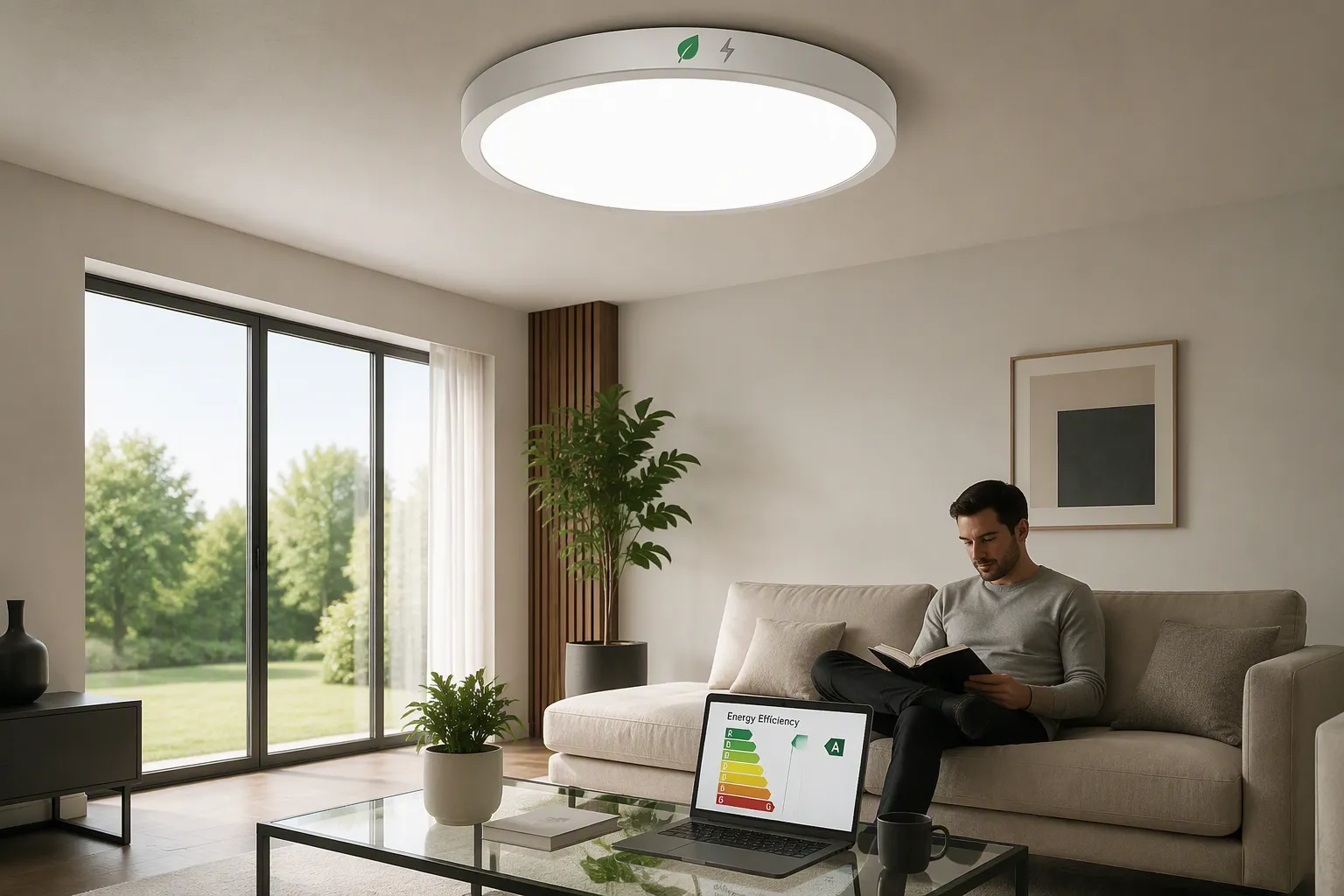
LED ceiling lights convert most electricity into visible light. They waste very little energy as heat. Traditional incandescent and halogen bulbs lose most energy as heat. This consumption pattern makes them costly to run. LEDs deliver the same brightness with a fraction of the wattage. This difference drives every energy savings advantage. A reputable LED Ceiling Light Manufacturer designs led light fixtures for maximum efficiency. Many led light manufacturers now offer energy-efficient lighting solutions. One LED Ceiling Light provides excellent energy-efficient lighting. The technology cuts energy consumption dramatically.
LEDs Turn More Electricity Into Light
The Basic Energy Conversion Difference
Every light bulb performs the same basic job. It takes electrical energy and converts it into visible light. The difference between bulb types lies in how much of that electrical energy becomes light and how much becomes heat. This ratio determines the overall energy efficiency of any lighting product.
Incandescent Bulbs: Heat First, Light Second
An incandescent bulb works by passing electricity through a thin wire filament. The filament resists the current and heats up until it glows. This glowing process produces light, but heat comes first. The filament must reach thousands of degrees before it emits any visible light at all. Roughly 90 percent of the energy an incandescent bulb draws escapes as heat. Only about 10 percent becomes visible light. A homeowner pays for 100 percent of the electricity and receives a small fraction of usable brightness in return.
LEDs: Light First, Minimal Heat
LED ceiling lights operate through a completely different principle called electroluminescence. When an electric current passes through a semiconductor material, it excites the electrons, causing them to release energy in the form of light. This process is inherently more efficient than incandescence, where heat is produced as a byproduct, wasting energy. The semiconductor design flips the old model. Light comes first, and heat appears only as a minor side effect.
The conversion process follows a precise sequence inside the LED chip:
Semiconductor structure: An LED chip is a two-terminal diode made from a semiconductor wafer (e.g., sapphire or silicon), with a P-type layer (doped with acceptor impurities having fewer valence electrons) and an N-type layer (doped with donor impurities having surplus conduction electrons), typically using III-V semiconductors like GaN, GaP, GaAs, or InP.
P-n junction formation: Where the P-type and N-type layers meet, a depletion region forms. Free electrons from the N-type layer migrate across the junction to fill holes in the P-type layer, creating negative ions and a reverse electric field that restricts further charge carrier diffusion.
Forward bias: When a sufficiently large forward voltage is applied across the depletion region, it overcomes the reverse electric field, allowing the diode to conduct.
Electron-hole recombination: Electrons jump across the p-n junction and recombine with holes, dropping to a lower energy state.
Photon emission: The excess energy from recombination is released as a photon — a packet of electromagnetic radiation in the visible spectrum (light). The wavelength depends on the bandgap energy, with direct bandgap semiconductors (e.g., InGaN for blue/green, InGaAIP for amber/red) enabling efficient radiative recombination.
The result of this process is striking. LED ceiling lights convert 95 percent of the electricity they draw into visible light. Only 5 percent escapes as heat.
Output Type | Percentage |
|---|---|
Light | 95% |
Heat | 5% |
This table captures the fundamental advantage. An incandescent bulb reverses those numbers almost exactly.
Why This Conversion Matters for Your Bill
Watts Measure Power Draw, Not Brightness
A common mistake involves reading wattage as a measure of brightness. Watts measure power draw. They tell a homeowner how much electricity a bulb consumes per hour of operation. Watts say nothing about how bright the bulb appears. A 60-watt incandescent bulb and an 8-watt LED bulb can produce nearly identical brightness. The wattage difference reflects how much electricity each bulb consumes to deliver that light.
Less Power Draw for the Same Light Output
The conversion difference directly reduces electricity usage. A typical household with 12 ceiling fixtures illustrates the gap clearly. An incandescent system using 65-watt bulbs draws 780 watts total. An LED system using 11-watt bulbs draws only 132 watts for the same brightness. Over five hours of daily use, the incandescent system consumes 3.9 kWh per day. The LED system consumes just 0.66 kWh.
Metric | Incandescent System (65W × 12 fixtures) | LED System (11W × 12 fixtures) |
|---|---|---|
Total wattage | 780 W | 132 W |
Daily consumption (5 hrs/day) | 3.9 kWh | 0.66 kWh |
Annual consumption | 1,424 kWh | 241 kWh |
Annual cost at $0.13/kWh | $185.12 | $31.33 |
Annual savings | — | $153.79 (~$12.82/month) |
10-year savings | — | $1,537.90 |
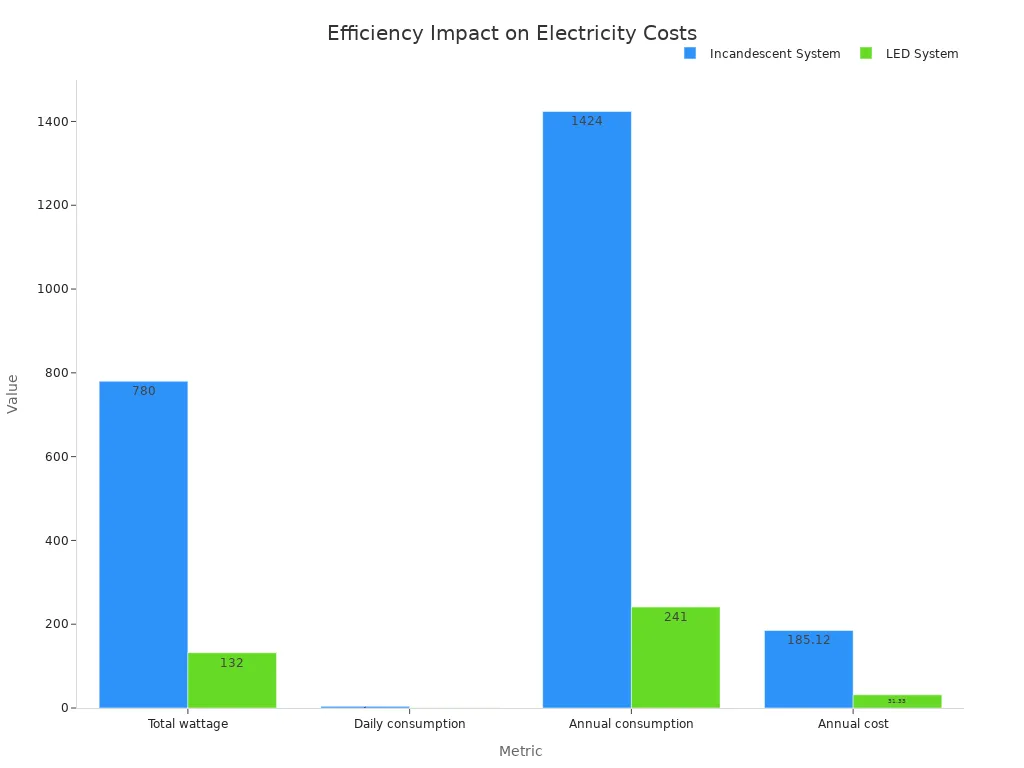
The numbers tell a straightforward story. LED fixtures achieve 70–100 lumens per watt, while incandescent bulbs reach only about 15 lm/W. LEDs produce 5–7 times more light per unit of electricity. They use 75–80% less electricity than incandescent bulbs for equivalent light output. LEDs also maintain 70%+ of initial brightness over a 50,000+ hour lifespan, whereas incandescent bulbs rapidly lose output while consuming the same wattage. LEDs generate minimal waste heat, reducing cooling loads by an estimated 10–15% in warm climates. A single LED fixture can last 27+ years at 5 hours daily use, eliminating recurring bulb replacement costs.
"A kitchen with eight recessed fixtures might consume 520 watts with old incandescent bulbs (65W × 8) but only 88 watts with LED equivalents (11W × 8). Over 1,500 annual operating hours, that's a difference of 648 kWh, which translates to roughly $84 in annual savings for just one room."
These savings extend beyond a single room. Every fixture converted to LED reduces the total energy consumption of a home. The lower power draw means less strain on the electrical system and lower monthly bills. Homeowners who switch to energy-efficient lighting solutions see immediate reductions in their electricity costs. The conversion advantage creates real energy savings that compound over time.
Lumens Per Watt: The Real Efficiency Score
What Lumens and Watts Actually Mean
Lumens Measure Brightness
A lumen quantifies the total amount of visible light a bulb emits. Higher lumens mean brighter light. This measurement allows consumers to compare brightness directly across different bulb types.
Watts Measure Energy Use
A watt indicates the electrical power a bulb consumes each hour. Many consumers mistakenly associate higher wattage with brighter light. This assumption holds true only within a single bulb type. Across different technologies, wattage provides no reliable brightness comparison. A 60-watt incandescent bulb and an 8-watt lamp produce nearly identical brightness.
Comparing Lumens Per Watt Across Bulb Types
The ratio of lumens to watts — lumens per watt (lm/W) — defines a bulb's efficiency. Higher lm/W means more light for each watt of electricity. The table below illustrates the dramatic differences across lighting technologies.
Lighting Type | Typical Efficacy (lm/W) |
|---|---|
Incandescent bulb | |
Halogen incandescent | |
Compact fluorescent (CFL) | 60–67 lm/W |
White-light LED lamp | >150 lm/W |
Incandescent and Halogen Ratings
Incandescent bulbs deliver only 16 lm/W. Halogen versions improve slightly to around 20 lm/W. Both types waste most of the input power as heat. They produce very little light per unit of electricity.
CFL Ratings
Compact fluorescent lamps reach roughly 60 to 67 lm/W. This rating represents a major improvement over incandescent technology. However, CFLs still lose some power during the gas and phosphor conversion process.
LED Ratings
Standard lamps using white LED chips exceed 150 lm/W. This high efficiency makes LED ceiling lights a superior choice for any room. The technology converts electricity into light with minimal waste.
Why a Higher Lumen-Per-Watt Number Saves You Money
More Light for Every Dollar Spent
A higher lm/W rating directly reduces electricity usage. The mechanism is straightforward. A fixture needs fewer watts to produce the same brightness. Lower wattage means lower energy consumption. Lower energy consumption reduces the annual electricity bill.
A typical home with twelve ceiling fixtures demonstrates the savings clearly. Incandescent bulbs at 65W each draw 780W total. Fixtures with 11W chips require only 132W total. This difference in energy consumption produces an annual energy savings of $153.79 at average electricity rates. The higher lm/W of this technology drives the reduction.
How to Read a Light Bulb Label
A light bulb label now displays lumens and watts prominently. Consumers should ignore wattage when comparing brightness. They should examine the lumen number instead. A higher lumen count with lower wattage indicates superior performance. Choosing fixtures with the highest lm/W rating maximizes energy savings over the product's lifetime. Selecting energy-efficient lighting starts with understanding these two numbers.
Minimal Heat Waste Sets LED Ceiling Lights Apart

How Incandescent Bulbs Waste Energy as Heat
The Glowing Filament Problem
An incandescent bulb generates light through a heated filament. Electricity flows through a thin tungsten wire. The wire resists the current and reaches temperatures above 2,000 degrees Celsius. This extreme heat produces a soft glow. The process wastes enormous amounts of energy. Roughly 90 percent of the electricity becomes heat. Only 10 percent becomes visible light. A homeowner pays for all 100 percent of that consumption. The bulb delivers a small fraction as usable brightness.
Extra Cooling Costs in Summer
Waste heat does more than inflate a lighting bill. It raises the ambient temperature inside a room. An air conditioner must remove that extra heat. This added workload increases energy consumption during warm months. A home with many incandescent fixtures fights a losing battle. The lights heat the room. The air conditioner cools it down. Both systems run harder. Both systems draw more power. This cycle drives up total energy costs.
How CFLs Still Lose Energy to Heat
Gas and Phosphor Conversion Losses
A compact fluorescent lamp produces light through a two-stage process. Electricity excites mercury vapor inside a glass tube. The vapor emits ultraviolet radiation. A phosphor coating then converts that radiation into visible light. Each stage loses energy along the way. Heat escapes during the gas discharge. More heat escapes during the phosphor conversion. A CFL still wastes a noticeable portion of its input power as thermal loss.
Warm-Up and Mercury-Related Drawbacks
A CFL requires a warm-up period before reaching full brightness. The bulb draws extra power during this start-up phase. Frequent switching shortens the bulb's life. These bulbs also contain small amounts of mercury. Disposal requires special handling. The mercury content adds an environmental cost to the product's lifecycle.
How LEDs Keep Their Cool
Semiconductor Light Emission
An led ceiling light produces light through electroluminescence. Electrons move across a semiconductor junction and release photons. This process generates very little heat. The design converts most electricity directly into visible light. This high efficiency separates LEDs from older technologies.
Heat Sinks Manage the Small Amount of Heat Produced
A small amount of heat still appears at the semiconductor junction. Engineers manage this heat with a heat sink. The heat sink pulls thermal energy away from the LED chip. Several design features make this possible:
Heat sinks extract waste heat from the LED junction through conduction via the metal-core PCB and thermal interface materials, then dissipate it to ambient air through convection and radiation.
Aluminum alloys with thermal conductivity of 90–240 W/mK maximize heat transfer from the PCB to the heat sink.
Fins and extended surfaces increase the area exposed to air, which improves convective heat transfer.
Active cooling with fans or liquid raises the convection coefficient from 5–20 W/m²K under natural convection to 25–250 W/m²K or higher.
This thermal management protects performance. Every 10°C rise in junction temperature reduces luminous flux and accelerates lumen depreciation by 30–50 percent. It also shifts the dominant wavelength by 1 nm. Proper heat sink design keeps these losses in check. The result is stable, energy-efficient lighting across the fixture's entire lifespan.
Directional Light Means Less Wasted Brightness
Why Traditional Bulbs Light Every Direction
Omnidirectional Output and Lost Light
An incandescent bulb emits light in every direction. The glowing filament sits at the center of a glass sphere. Light radiates outward in a full circle. Half of that light travels upward toward the ceiling. Another portion scatters sideways into walls. Only a fraction reaches the surface below. This omnidirectional output wastes a large share of the bulb's total brightness.
The Need for Reflectors and Shades
Homeowners often add reflectors or shades to redirect stray light. These accessories capture some of the lost output. They cannot recover all of it. Each reflection loses a small amount of light. The fixture grows more complex. The overall efficiency drops further. A simple bulb becomes a system of parts that each reduce performance.
How LEDs Focus Light Where You Need It
Built-In Directional Design
An led ceiling light emits light from a flat semiconductor surface. This design produces a focused beam by nature. Photons leave the chip in a controlled direction. A lens or reflector then shapes the beam pattern. Almost all the light lands on the intended surface. Very little escapes into unused space.
Fewer Fixtures Needed for the Same Coverage
Directional output changes fixture planning. A room may need six omnidirectional bulbs for even brightness. The same room may need only four directional led ceiling lights. Each fixture delivers more usable light to the target area. Fewer fixtures mean lower total wattage. Lower wattage reduces energy consumption across the whole room.
The Practical Result for Homeowners
Lower Wattage for Equal Room Brightness
Directional design lets a fixture achieve the same room brightness with less power. A 15-watt directional fixture can match a 60-watt omnidirectional bulb in perceived brightness. This gap lowers energy consumption for every hour of use. The savings appear on each monthly bill.
Less Light Spilling Into Unused Spaces
Traditional bulbs send light into closets, hallways, and empty corners. That spill serves no purpose. Directional fixtures aim light at floors, desks, and countertops. This precision cuts waste at the source. Homeowners who choose energy-efficient lighting with directional output capture more usable light from every watt. The result is better illumination with less energy.
A Longer Lifespan Compounds the Savings
These fixtures serve as an energy-efficient option that delivers long-term financial benefits. Their exceptional lifespan reduces both replacement costs and hidden energy consumption.
How Long LED Ceiling Lights Really Last
Rated Hours Compared to Incandescent and CFL
A quality fixture provides many more operating hours than older bulb technologies. The table below shows typical rated lifespans.
Bulb Type | Average Rated Lifespan |
|---|---|
Incandescent | ~1,000 hours |
CFL | ~8,000–10,000 hours |
LED (bulbs) | 25,000–50,000 hours or more |
LED (ceiling fixtures) | 25,000–50,000 hours (high-quality commercial: 70,000–100,000+ hours) |
CFLs had a lifespan of 6,000 hours. LED bulbs are supposed to last upwards of around 25,000-50,000 hours.
Fewer Burnouts and Replacements
The L70 rating defines the point when light output drops to 70% of original brightness. For a household using fixtures 6 hours per day, a quality fixture rated for 50,000 hours lasts approximately 22.8 years. Incandescent bulbs require replacement every year. CFLs need replacement every few years. A fixture that lasts decades eliminates recurring burnout cycles.
The Hidden Energy Cost of Making and Replacing Bulbs
Manufacturing and Shipping Overhead
Every bulb requires energy for manufacturing, packaging, and transportation. Frequent replacements increase the total energy consumption embedded in the lighting product. Incandescent bulbs waste more energy in production relative to their short service life. A fixture spreads its manufacturing energy over many years and lowers overall energy consumption.
Trips to the Store and Disposal Waste
Homeowners must buy replacement bulbs regularly for short-lived technologies. Each trip to the store consumes fuel. Disposal of burned-out bulbs adds waste. Quality models eliminate these trips for many years. This reduction cuts both direct and indirect energy consumption.
Why Fewer Replacements Mean Lower Long-Term Costs
Savings Beyond the Electricity Bill
The efficiency comparison extends beyond the electricity bill. Energy-efficient lighting reduces overall household costs. Incandescent bulbs require roughly 10 replacements over 10 years, costing about $15 total. A single LED bulb costs about $5 and lasts the entire decade. Electricity costs for a 60W incandescent run about $85 over 10 years, while a 10W equivalent runs only $14. The total 10-year cost per fixture shows an 81% reduction with LED.
Convenience for Hard-to-Reach Ceiling Fixtures
Ceiling fixtures in high rooms make replacement difficult. A professional may charge $50–$150 per replacement. Incandescent bulbs in such fixtures require service every 12–18 months. A fixture eliminates that labor for 10+ years. This convenience adds significant value to the overall energy savings.
Dimmability and Smart Controls Add Extra Savings
How Dimming Cuts Energy Use
Lower Wattage at Lower Brightness
Dimming reduces power draw in modern led ceiling lights. A dimmer switch lowers the voltage sent to the fixture. The led chip then draws fewer watts. This reduction directly cuts energy consumption. The savings are substantial at moderate dimming levels.
Dimming to 50% brightness typically reduces energy consumption by 40-45%
This relationship differs between older bulbs and modern led technology. The table below compares both types.
Lighting Type | Relationship Between Dimming Level and Power Consumption | Comparison Notes |
|---|---|---|
Incandescent bulbs | Power consumption decreases proportionally as brightness is lowered; reduced voltage leads to lower energy draw. | Dimming produces direct and noticeable energy savings. |
LED bulbs | Modern LEDs can scale power usage based on the dimmed level, so lower brightness can reduce energy consumption. | Savings depend on compatibility with the dimmer switch; improper pairing may cause flickering, reduced lifespan, or suboptimal energy savings. |
Better Match to Real Lighting Needs
Homeowners rarely need full brightness at all hours. Evening reading requires less light than a dinner party. Dimming lets a fixture match actual lighting needs. This precision avoids wasted energy. A room uses only the light it requires at any given moment.
Smart Features That Reduce Waste
Motion Sensors and Occupancy Detection
Motion sensors turn lights on only when someone enters a room. They shut off fixtures after a period of inactivity. This automation eliminates waste in empty spaces.
Lighting energy use reduced by 30-60% in residential settings, with up to 90% savings in low-occupancy areas like storage rooms.
Occupancy sensing (motion detection) typically saves 18% on lighting energy.
Yearly energy cost savings up to $225 for an average household using motion sensor lights with LED bulbs.
Energy reduction of 35-50% by automatically turning off lights when room is unoccupied.
Scheduling and Daylight Harvesting
Scheduling sets fixtures to turn on and off at specific times. Daylight harvesting adjusts brightness based on natural light levels. Both features cut unnecessary consumption.
Control Combination | Percentage of Cases Achieving ≥20% Savings | Percentage of Cases Achieving ≥30% Savings |
|---|---|---|
Daylight harvesting only (DLCS) | 39% | 8% |
Daylight harvesting + occupancy off | 100% (always) | 74% |
App and Voice Control Convenience
Smart apps let users control fixtures from a phone. Voice assistants add hands-free operation. These tools make it easy to dim lights or turn them off. Convenience encourages consistent use of energy-saving settings.
Why Controls Multiply LED Efficiency
Lights Off When Rooms Are Empty
Occupancy sensors ensure fixtures operate only when needed. An empty room draws zero watts. This simple rule prevents the most common form of waste.
Right Light at the Right Time
Dimming and scheduling deliver the correct brightness for each activity. This precision maximizes the efficiency of every fixture. Together, these controls turn energy-efficient lighting into a fully optimized system.
Putting the Savings Into Real Numbers
A Simple Watt-for-Watt Comparison
Incandescent Versus LED Ceiling Fixtures
A direct watt-for-watt comparison reveals the true gap between old and new technology. A single 60-watt incandescent bulb draws 60 watts of power. A comparable led ceiling light draws only 9 watts. This difference means the led fixture uses 85 percent less energy for the same brightness. A ceiling fixture with three incandescent bulbs draws 180 watts total. The same fixture with three led bulbs draws just 27 watts.
Configuration | Total Wattage (W) | Annual Cost ($) |
|---|---|---|
Three 60W incandescent bulbs | 180 | 35.46 |
Three 9W LED bulbs | 27 | 5.91 |
Estimated Annual Electricity Cost
The annual cost difference is striking. A single 60-watt equivalent led ceiling light running 8 hours per day costs about $4.95 per year. An incandescent equivalent costs about $98.97 per year. This comparison shows an estimated annual savings of roughly $94.02 per bulb. These figures use the national average residential electricity rate.
Bulb Type | Wattage | Daily Usage | Annual Cost |
|---|---|---|---|
LED (60W equivalent) | 9W | 8 hours/day | ~$4.95/year |
Incandescent | 60W | 8 hours/day | ~$98.97/year |
What Homeowners Can Expect on Their Bills
Short-Term Savings
A household replacing all ceiling lights with LEDs sees immediate reductions. A typical home with 12 fixtures using 65-watt bulbs draws 780 watts total. The same home with 11-watt led fixtures draws only 132 watts. Annual consumption drops from 1,424 kWh to 241 kWh. At $0.13 per kWh, the annual cost falls from $185.12 to $31.33. This change produces an annual savings of $153.79, or about $12.82 per month.
Long-Term Savings Over the Bulb's Life
Long-term savings compound over time. A 60W incandescent bulb replaced by a 9–10W led bulb with similar brightness, used 8 hours daily, consumes about 14.4 units per month versus only about 2.4 units for the led. At an average electricity cost of ₹6–₹7 per unit, this yields noticeable monthly savings. Replacing multiple lights in a home can significantly reduce electricity costs. These energy savings accumulate year after year.
How to Choose Energy-Efficient Lighting for Your Ceiling
Check the Lumen-Per-Watt Rating
Consumers should examine the lumen-per-watt rating on every package. A higher number indicates greater efficiency. This single metric predicts real energy consumption better than wattage alone.
Look for ENERGY STAR Certification
The ENERGY STAR label confirms independent testing. Certified products meet strict standards for energy use. This certification simplifies the search for energy-efficient lighting solutions.
Match Color Temperature and Brightness to the Room
Color temperature affects comfort and perceived brightness. Warm white suits bedrooms and living rooms. Cool white works well in kitchens and workspaces. Matching these settings to each room prevents wasted light. Smart energy-efficient choices start with the right specifications for the space.
Every energy efficiency advantage of led ceiling lights traces back to one core fact. They turn electricity into light, not heat. High lumens per watt, minimal heat waste, directional output, long lifespan, and smart controls all build on that foundation. Together, these features lower electricity bills, reduce replacements, and cut hidden energy consumption from manufacturing and disposal. Homeowners who compare lumens per watt and seek ENERGY STAR ratings lock in energy savings from day one. This energy-efficient choice delivers lasting value. A smart energy-efficient option pairs quality fixtures with efficient lighting solutions. The led market offers many strong products. Buyers who prioritize efficiency gain the most. Lower consumption and reduced energy use follow naturally. Every watt saved adds up over time.
FAQ
What does lumens per watt mean for LED ceiling lights?
Lumens per watt measures how much visible light a fixture produces for each watt of electricity. A higher number means better efficiency. LED ceiling lights exceed 150 lumens per watt. Incandescent bulbs reach only about 16 lumens per watt.
Why do LED ceiling lights waste less heat than incandescent bulbs?
Incandescent bulbs heat a filament until it glows. That process turns roughly 90 percent of electricity into heat. LED ceiling lights use electroluminescence instead. Electrons release photons directly. Only about 5 percent of the energy becomes heat.
Do LED ceiling lights really last longer than other bulbs?
Yes. Incandescent bulbs last about 1,000 hours. CFLs reach 8,000 to 10,000 hours. Quality LED ceiling lights run 25,000 to 50,000 hours or more. A fixture used six hours daily can last over 20 years.
Can dimming an LED ceiling light reduce energy use?
Dimming lowers the wattage an LED fixture draws. A light dimmed to 50 percent brightness typically cuts energy consumption by 40 to 45 percent. Homeowners save more when they match brightness to the actual task.
How do smart controls improve LED ceiling light efficiency?
Motion sensors turn fixtures off in empty rooms. Scheduling and daylight harvesting adjust brightness automatically. These features eliminate waste from lights left on. Occupancy sensing alone saves about 18 percent on lighting energy.
What should a homeowner check before buying an LED ceiling light?
Buyers should check the lumen-per-watt rating first. A higher number signals greater efficiency. The ENERGY STAR label confirms independent testing and strict standards. Matching color temperature to each room also prevents wasted light.
Do LED ceiling lights cost more upfront?
LED ceiling lights often cost more at purchase. However, lower wattage cuts electricity bills immediately. A typical home saves about $153 annually by switching 12 fixtures. Long lifespan eliminates replacement costs for over a decade.
How much can a household save with LED ceiling lights?
A home with 12 fixtures saves roughly $153.79 per year at average electricity rates. Savings grow over time through fewer replacements and lower cooling loads. Ten-year savings can exceed $1,500 for one household.